Used cars: 11 days from photos to published listing
Used-car time-to-market covers washing, reconditioning, pricing, photos and publication. The photographic stretch is the part that can be automated: CarTake handles it from the app to the multipublisher.
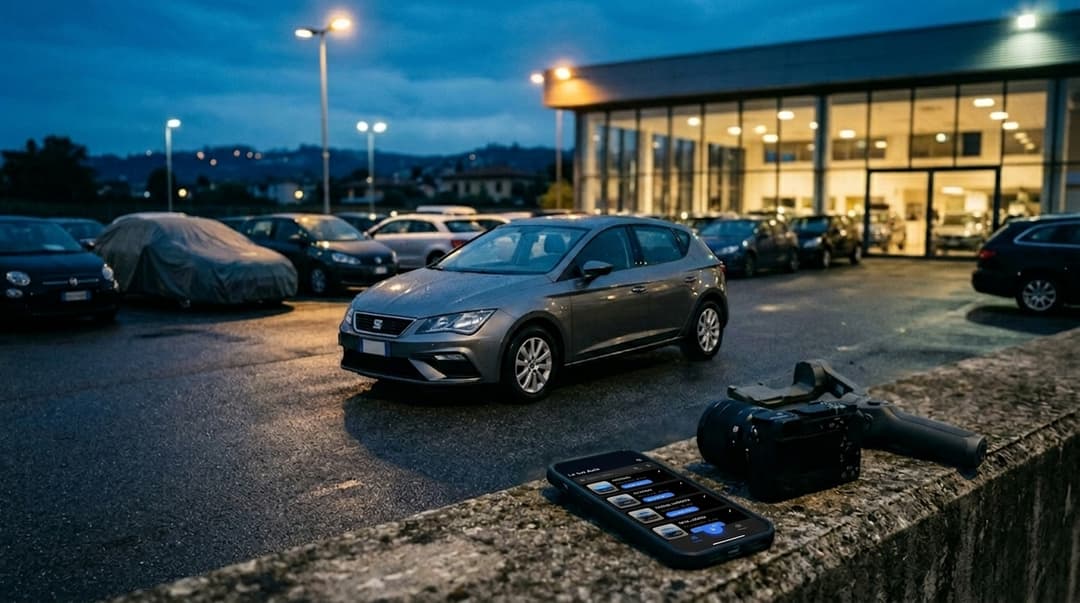
In Italy, used-car time-to-market averages 45 days; 11 of them sit between photos and publication, versus 1 at the best-performing dealers. Where CarTake fits, and which KPIs to track.
According to the 2024 Web Industry Observatory, used-car time-to-market in Italy averages 45 days; the fastest operators publish in 13. Within that cycle, an average of 11 days passes between photo upload and listing publication, versus 1 day at the best performers.
Time-to-market includes logistics, washing, reconditioning and pricing, plus capture, post-production and publication. CarTake acts on the last three phases: it guides the shoot on the lot, removes the background and standardises the images in 30–60 seconds, and delivers them directly to the multipublishers (SmilePhotoWeb, Publisher, WEICOLA, etc.). Preparation and pricing remain with the dealer. On used stock, where TTM is more than double that of new vehicles (45 days versus 21), publishing earlier means starting the sales phase earlier.
What time-to-market means at a dealership
Dealership time-to-market is the time from inventory intake to listing publication. It is not time-to-sell. In 2024 the observatory measures 21 days for new vehicles and 45 for used; the best reach 5 and 13. On used cars the observed gap is 32 days.
TTM is a sequence of phases: collection, washing, reconditioning and pricing, then capture, post-production and publication on the website and the marketplaces. Back in 2023 the observatory already flagged the preparatory phase as the indicator to optimise; in 2024 the unit of measure is still the day.
"Until the listing is published, the vehicle is in stock but not on the market."
— AitomotiveLab
Time-to-market, time-to-sell and holding time are not the same
Time-to-sell starts when the listing is live and ends at the sale. Holding time, for the observatory, is the sum: TTM + TTS. In 2024 TTS averages 55 days new and 73 used; the best sell in 24 and 19. Adding the 2024 slices gives a used cycle of 118 days on average and 32 at the best; new 76 and 29. About 38% of the used cycle (45/118) and 28% of the new cycle (21/76) is consumed before the car is online.
This is where stock rotation comes in. Shortening capture, post-production and publication does not reduce time-to-sell on its own, but it starts it earlier; on used stock, where 38% of the cycle is consumed before the listing goes live, that head start matters more than on new vehicles. In 2025, on a panel of 495 dealership locations, the observatory reports an average holding time of 83 days for new vehicles and 80 for used. The 2024 and 2025 surveys are not directly comparable, but they confirm that a standing vehicle is a cost, and that the photos-to-publication stretch is the first one operations and marketing can act on together.
How long it takes from photos to publication
In the cycle breakdown, the average used car in Italy takes 11 days from photo upload to publication; the best performers take 1. The source is the November 2024 InterAuto analysis of the vehicle lifecycle. Among the optimisation levers, Web Industry cites 7–15 quality photos, alongside logistics, DMS, pricing and advertising. The stretch between a completed photo set and a published listing is the one a structured photo flow can reduce.
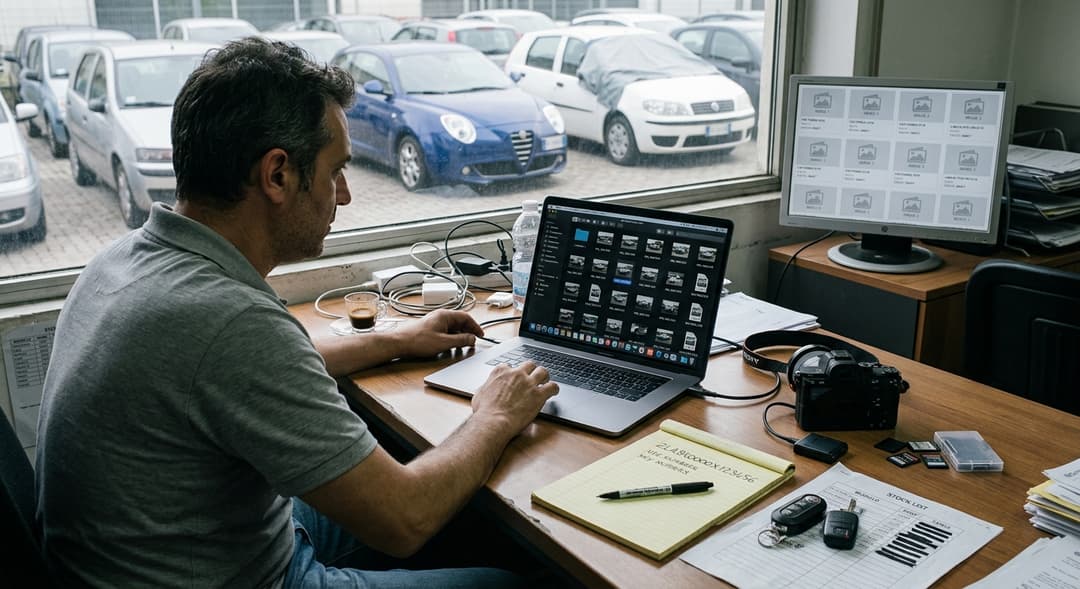
The 11 days do not come from image processing time, but from manual steps: moving the vehicle to the photo area, waiting for the photographer, downloading the cards, renaming files, uploading them to the multipublisher. CarTake processing takes 30–60 seconds per image — cut-out, Digital Room, logo, ready file; the rest of the time is organisation, and that is where an automated flow makes the difference.
Where CarTake shortens time-to-market
CarTake Photo is the app that guides the shoot; CarTake Studio handles branding and content distribution. Three phases of the workflow affect used-car time-to-market.
- Capture: the vehicle is photographed where it sits. Scan the plate or VIN and the app indicates angles and sequence (3/4, side, rear, interior). No studio and no dedicated photographer required.
- Post-production: the vertical AI, trained on an automotive dataset, cuts out glass, wheels and chrome, places the vehicle in the Digital Room and applies logo and branding. 30–60 seconds per image, in parallel, with automatic quality control.
- Publication: photos go to the multipublishers without downloads, renames or uploads — SmilePhotoWeb, Publisher by Infinity, WEICOLA, etc., among the most widely used on the Italian market. From there they reach the website and the marketplaces.
If the dealership uses a multipublisher that is not yet covered, the CarTake team builds the integration around the dealer's needs. Washing, reconditioning and pricing, on the other hand, stay outside the perimeter: CarTake does not replace them. With preparation already under way, the vehicle can be online the same day it is photographed. The effect on rotation is direct: the listing starts generating enquiries earlier.
What a day of delay costs
In 2025 the observatory, on a panel of 495 Italian dealership locations, estimates the cost of a standing vehicle at €11 per day. InterAuto News and Data Manager report the same study, with an average holding time of around 80 days.
Applied to the photos-to-publication stretch, the order of magnitude is this: 100 vehicles with 5 days of delay at €11 per day are worth €5,500. If the delay comes from washing or pricing, the photo flow does not recover it. If the shoot is done and the images are waiting for processing and upload, that cost can be removed.
Speed and quality: why photos matter for rotation
Publishing earlier is not enough if image quality is poor. In Shift Digital's 2025 report, up to 75% of dealer-site traffic concentrates on listings and vehicle detail pages. Vehicles with high-quality images record over 20% more engagement; dealer-branded backgrounds add around 5%. Photos of the actual vehicle, versus catalogue images, are worth roughly +50% CTR and −36% CPC. That is why cut-out, Digital Room and per-brand environments (OEM programme, location, campaign) are part of merchandising, not a cosmetic touch.
As early as 2018, Cox Automotive observed the same dynamic in the United States: more real photos of the vehicle, versus a single catalogue image, increased clicks through to the detail page. On used stock the customer compares specific vehicles, not models: the real photo is the first element of evaluation.
Do you need a photo studio to publish inventory?
No. You shoot on the lot: the app indicates framing and distance, and the AI brings every vehicle to the same visual standard. A physical studio remains a brand choice, not a publishing requirement. The commercial lever is the per-vehicle digital environment — OEM used programme, dealer brand, premium line or campaign — assigned from the platform, with no set to book. Selection criteria are covered in the guide to AI dealership photography.
Three steps: capture, post-production, publication
The CarTake Photo workflow runs from the app to publication, with no manual uploads in between.
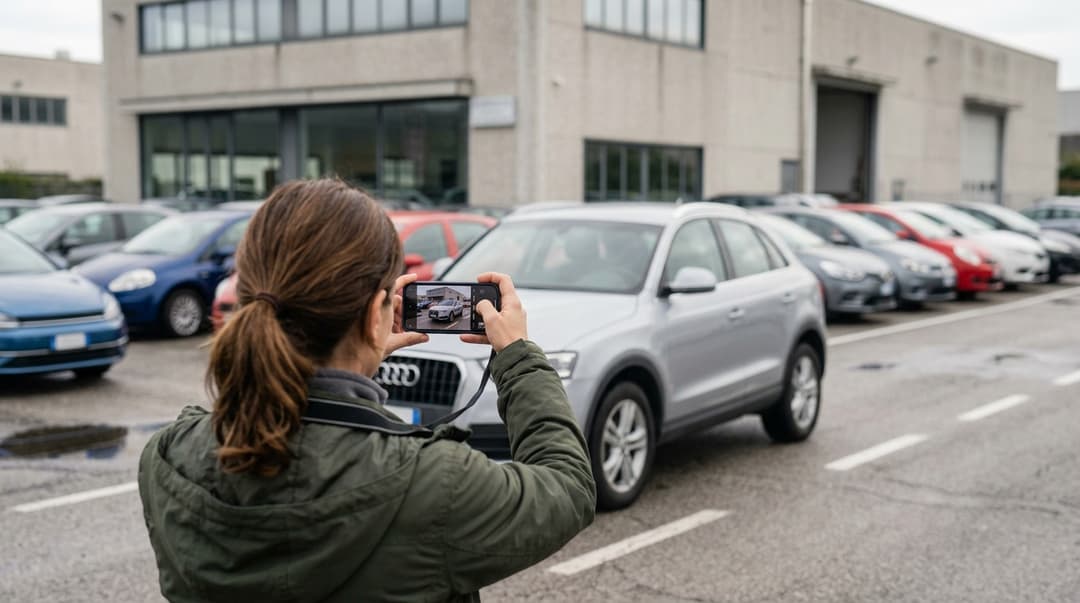
- Shoot with the app: plate or VIN, guidance on angles, full sequence on the lot.
- The AI processes automatically: cut-out, Digital Room, logo, quality control. 30–60 seconds per photo.
- Images go to the multipublisher (SmilePhotoWeb, Publisher, WEICOLA, etc.) and from there to the website and the marketplaces.
The KPIs to measure on the photos-to-publication stretch
To verify whether the photo flow is shortening TTM, it helps to separate process indicators from commercial ones: first identify where the days pile up, then measure the effect on the listing.
- Time-to-photo: intake → completed photo set (after washing and preparation).
- Time-to-publish: completed set → listing actually live. The KPI CarTake can influence.
- % live within 24/48 hours of the shoot: an SLA between operations and marketing.
- Manual steps per vehicle: downloads, renames, uploads, checks.
- Branding coverage: share of listings with the correct Digital Room and logo.
Clicks, detail-page views and cost per click are measured later, once the stock is online. The sources cited are public and listed below. For an operational assessment of the flow: CarTake or request a demo.
FAQ
Time-to-market and used inventory publication
The questions operations and marketing teams ask about the stretch from photos to listing, and where CarTake fits.
Want to shorten the days between photos and publication?
We will walk you through guided capture, cut-out, Digital Room and automatic multipublisher delivery on your dealership's real flow.