MIA · Service and after-sales

AI for the dealership Service department: from request to workshop appointment

The Service department receives calls, messages, and website requests while advisors are busy with customers at the desk. MIA answers on voice, WhatsApp, and webchat, collects plate, need, and preferred time, and prepares the booking or callback according to workshop rules. The advisor receives a complete request, not a missed call.

  • Maintenance, repair, and inspection requests
  • Booking, rescheduling, and cancellation via the connected calendar
  • Authorized reminders and follow-up on WhatsApp
  • Handoff to the service desk with summary and collected data

AI mode and Human Control

AI handles the expected requests. The service desk decides on the rest.

Not everything in a workshop can be automated: a noise to diagnose, a quote, a complaint. MIA works in two distinct modes, configured department by department.

AI mode

MIA autonomously handles recurring Service requests using the information provided by the dealership and the fields defined during setup.

  • Collects plate or model, location, type of work, and preferred date.
  • Answers about hours, location, documents to bring, and services like courtesy cars, where configured.
  • Proposes or records a slot when calendar and integration allow it.
  • Sends authorized reminders and confirmations on enabled channels.

Human Control

The advisor or Service manager takes over when technical or commercial judgment is needed. AI stops, context stays.

  • Diagnosis, quotes, and non-standard jobs.
  • Complaints, warranty cases, and decisions.
  • Customers who explicitly ask for a person.
  • Any flow the dealer prefers to manage directly.

Switching between modes follows configured rules: by request type, time, location, or keyword. The team always sees who is replying and can step in at any time.

Why Service loses requests even when the workshop is full

Service requests arrive in bursts: in MIA data, 350 of 620 Service opportunities fall between 8 am and 1 pm, the same window in which advisors hand over and receive vehicles. The phone rings while a customer waits at the desk, and the WhatsApp message stays read but unanswered.

An AI assistant for Service exists first of all for this: absorbing the first stage of the request and delivering it complete to the person who will handle it.

What MIA handles for workshop and after-sales

MIA covers recurring after-sales requests with the same conversational engine used for sales, but with department-specific fields, rules, and calendar. Every flow ends with a clear operational outcome: appointment proposed or recorded, complete request for the desk, scheduled callback.

  • Scheduled maintenance: plate, approximate mileage, location, and preferred time.
  • Repairs and checks: the problem described in the customer's words, ready for the advisor.
  • Tyres and seasonal changes: peak requests that saturate the switchboard.
  • Job status and pickup: information only when it comes from connected, authorized systems.
  • Rescheduling and cancellation, with calendar updates where integration allows.
  • Appointment reminders and agreed deadlines on channels authorized by the customer.

Phone, WhatsApp, and website: one Service flow

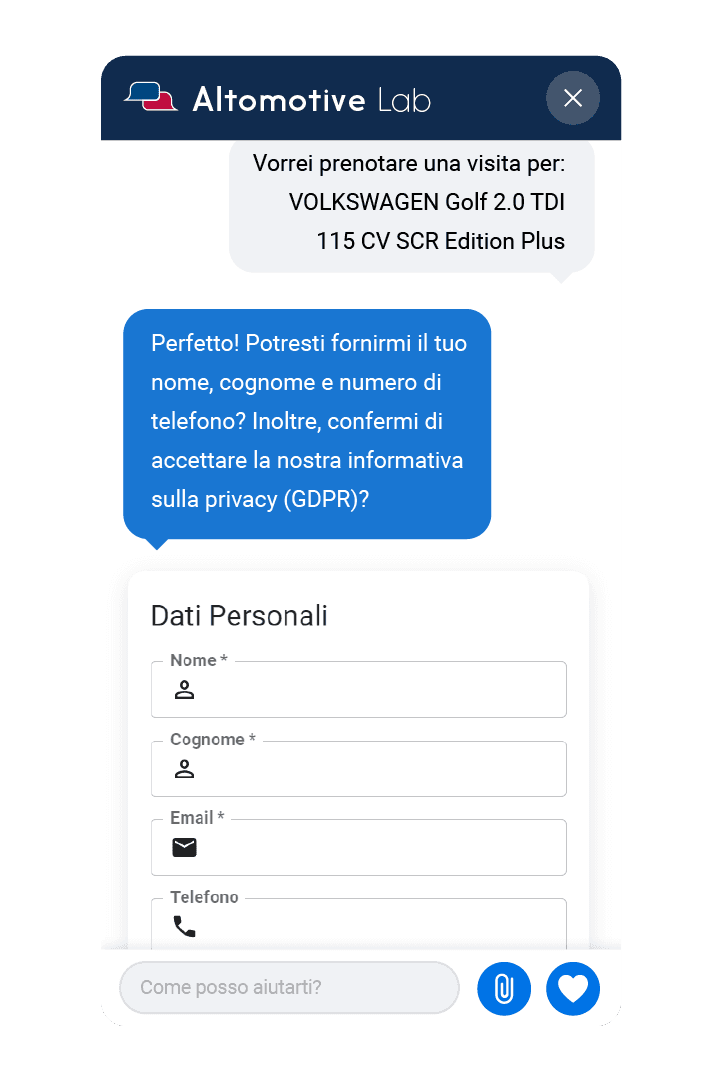
The customer chooses the channel; the workshop receives the same structured request. On the phone MIA works as a voice assistant; on WhatsApp the conversation can continue over time with reminders and confirmations; on the website the chat intercepts people searching for a service booking before they abandon a form.

In the 30 days observed from 7 August to 6 September 2026, Service opportunities with a linked first message totaled 624: 362 from voice, 203 from webchat, and 59 from WhatsApp. Phone remains the main after-sales channel, but a third of requests already come through digital channels.

How it works: from request to service desk

The flow is designed never to present a preference as a confirmed appointment. What is communicated to the customer depends on what calendar and integrations actually allow.

  • 1. The customer calls, writes on WhatsApp, or opens the website chat.
  • 2. MIA recognizes a Service request and collects the fields defined by the workshop.
  • 3. If calendar and integration allow it, it proposes available slots and records the booking; otherwise it prepares the request and schedules a callback.
  • 4. The service desk receives summary, data, and source channel, and steps in when judgment is needed.

Follow-up and Service campaigns on WhatsApp

After-sales runs on deadlines: maintenance, inspections, tyre changes, warranty expiry. With MIA outbound campaigns the dealership can import lists from CRM, DMS, or files, segment them, and start one-to-one WhatsApp conversations within collected consents.

When the customer replies, MIA continues the dialogue, collects availability, and moves the contact toward an appointment or handoff. Sending rules, hours, and templates are defined before activation.

Integration with workshop calendar, CRM, and DMS

MIA manages the conversation; the workshop calendar, CRM, and DMS remain the systems of record. Before activation we verify which reads and actions are available: slot lookup, appointment recording, customer record, vehicle, job status.

Available CRM integrations with Action, LeadSpark, Walcu, Salesforce, Tcar, and Visual Software allow the Service request to be recorded in the customer's context. Calendar and DMS scope is agreed per project.

What to measure in an AI project for Service

Early indicators concern the flow: Service requests by channel and time band, share handled by AI without intervention, time to first reply, complete requests delivered to the desk, handoffs and reasons.

Completed appointments, no-shows, workshop revenue, and retention are later stages: they become comparable only when calendar and DMS record outcomes consistently before and after activation.

Service and workshop FAQ

AI for the dealership workshop: frequently asked questions

Bookings, channels, calendar, and human control: what Service managers ask before activating MIA.

It can collect the request and, when the workshop calendar and integration allow it, propose slots and record the appointment. If the action is not available, MIA prepares a complete request for the desk or schedules a callback, without presenting a preference as a confirmation.

Phone, WhatsApp Business, and website chat. The flows share the department's fields and rules, so the desk receives the same structured request regardless of the channel.

Yes. With Human Control the team takes over the chat or request at any time; AI stops and the collected context stays visible. Handoff can be automatic on defined rules, for example quotes, complaints, or requests to speak with a person.

Only when status comes from a system connected and authorized by the dealership. Without the integration, MIA collects the request and passes it to the workshop rather than providing unverified information.

Yes, through MIA outbound WhatsApp campaigns: list import, segmentation, approved templates, and a managed conversation when the customer replies. Consents, hours, and sending rules are defined before activation.

Want to see MIA on your workshop's Service flow?

We review requests by channel and time, calendar, integrations, and handoff rules to the service desk together.