Digital solutions for the automotive aftermarket: what dealership aftersales really needs
Phone, WhatsApp, webchat, calendar and CRM: which Service steps are worth digitalising, under which constraints, and what should stay with the service advisors.
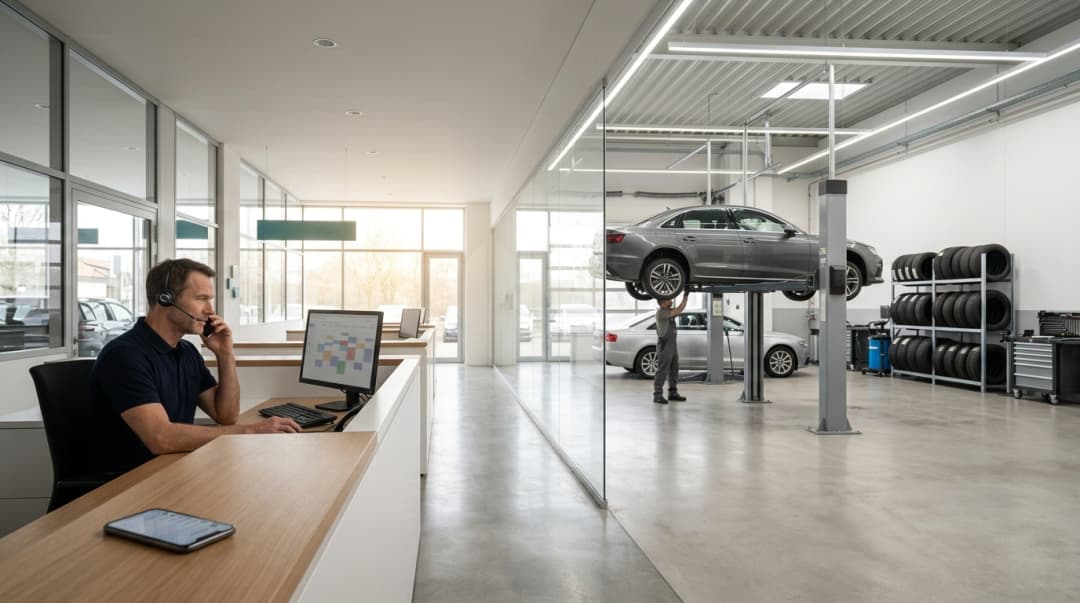
A practical guide to digital aftersales in dealerships: inbound channels, service bookings, calendar and DMS, the metrics to track and the limits of automation.
The automotive aftermarket usually brings to mind parts distributors and independent garages. For a dealership, though, the aftermarket largely means aftersales: scheduled maintenance, tyres, recalls, bodywork and warranty. Unlike a sale, it is work that repeats throughout the life of the car.
This guide is not about parts distribution software. It looks at Service processes inside the dealership and at the digital solutions that make them more reliable: where requests arrive, how they become appointments, how they reach the CRM and what should remain with people.
Why the aftermarket matters to dealerships
According to the ACI 2026 Statistical Yearbook, the median age of Italy’s passenger car fleet in 2025 was 13 years, essentially unchanged on the previous year. For petrol cars it is over 16 years. An ageing fleet generates a steady flow of maintenance and repair work, even when new-car sales slow down.
The ANFIA Aftermarket Barometer recorded a 1.3% drop in independent parts supply-chain revenue in 2025, after four years of growth. Among the possible reasons for the fall in electrical and electronic components, ANFIA points to a shift towards newer vehicles still under warranty and therefore less reached by the independent channel. For dealerships the message is clear: while the car is under warranty the customer returns to the official network more easily; afterwards, the choice depends on how easy it is to book and how well the customer is followed up.
Staffing is the other issue. Research by Centro Studi Tagliacarne presented in May 2026 found that two in three aftermarket companies struggle to hire qualified people. Service desks are short-staffed too: every minute spent answering the same phone questions is a minute taken from the customer at the counter or the car on the lift.
Where aftersales loses value
The problem is rarely a lack of demand. More often requests do arrive, but they get scattered across phones, personal chats and sticky notes before becoming an appointment.
- Unanswered calls while the service advisor is at the counter with a customer or in the workshop.
- Requests received after hours that nobody picks up the next morning.
- Appointments written on paper or kept in someone’s head, with no record in the CRM.
- Service and recall reminders that are not sent, or are sent without verifiable consent.
- Customers having to repeat their registration and problem at every step.
Many of these points concern first contact, the same topic covered in the dealership BDC guide. The difference is that in aftersales first contact is often a phone call, answered by the same person who is already dealing with customers at the service desk.
The phone is still Service’s first channel
Customers who need a service or have a warning light on tend to call. An AI phone agent does not replace the service desk: it answers when the team is busy or the dealership is closed, collects the registration, site, job type and preferred date, and passes a complete request to the service advisors.
At Autocentri Balduina, MIA Voice steps in only when every BDC operator is busy or the business is closed. Between 15 May and 9 September 2026 it handled 6,366 calls: of the 3,480 opportunities recorded in the CRM, 2,500 concerned Service.
The voice channel, with inbound and outbound calls and handover to an operator, is described on the AI phone agent for dealerships page.
WhatsApp and webchat: written requests
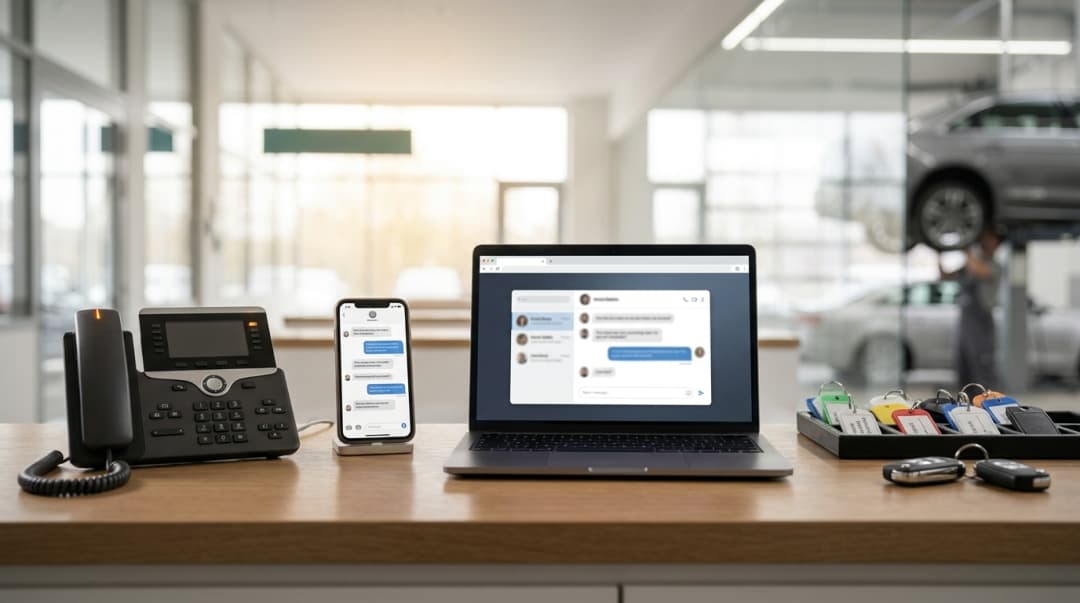
On WhatsApp customers send a photo of a warning light, ask whether the car is ready or move an appointment. These are short requests, but they have to be matched to the right vehicle and the right person. The dealership can reply freely within 24 hours of the customer’s last message; reminders require opt-in and approved templates. The operating steps are covered in the guide to 7 WhatsApp automation workflows and on the WhatsApp for dealerships page.
On the website, someone searching for a service booking should get an immediate answer, not a form followed by a wait. In our Summer 2026 Report, Service requests are concentrated mainly between 8 am and 6 pm, while sales enquiries continue into the evening: a useful signal for deciding how to cover each channel. The dealership AI webchat brings the request to the service desk with the details already collected.
From request to appointment: services, tyres and reminders
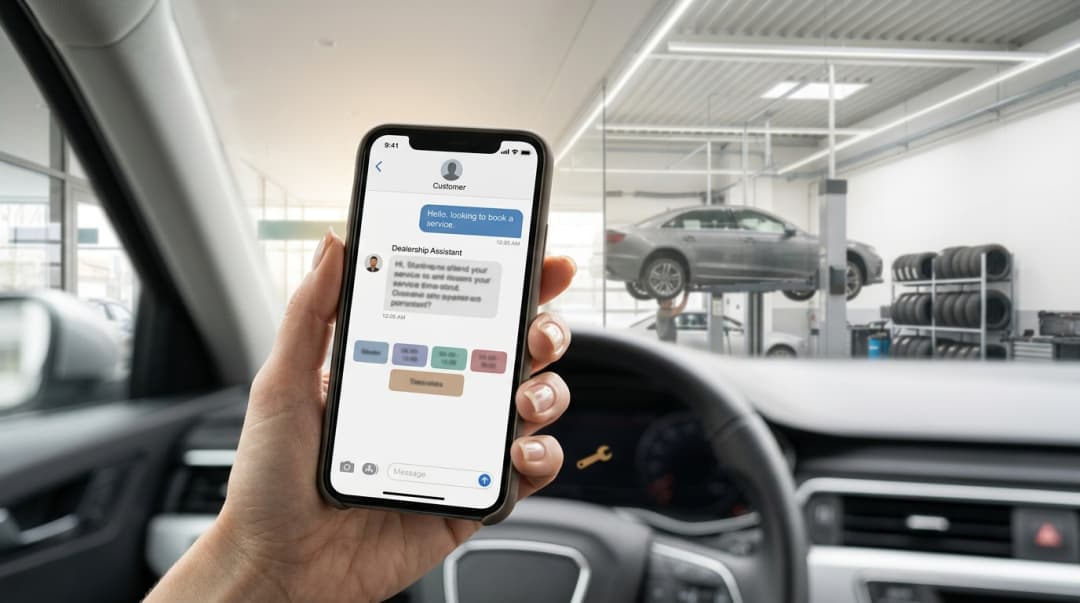
A scheduled service or tyre change needs only a few details: registration or model, approximate mileage, site, job type and a preferred date. A well-configured assistant collects them by following the conversation and shares information already approved by the dealership on opening hours, documents or courtesy cars.
The key point is the difference between a request and an appointment. If the workshop calendar is connected and allows write access, the slot can be recorded, moved or cancelled. If it is not, the preference is passed to the service desk without being presented as confirmed.
- Has the registration or vehicle been identified?
- Does the proposed slot come from the calendar, or is it just the customer’s preference?
- Does the service desk receive a readable summary without having to call the customer back?
The same applies to reminders: service due dates, periodic roadworthiness inspections, seasonal tyre changes. They are useful when they start from reliable data and recorded consent, and when replies reach a staffed queue. Aftersales features are described on the AI for Service and workshop page.
Calendar, DMS and CRM: where the process succeeds or fails
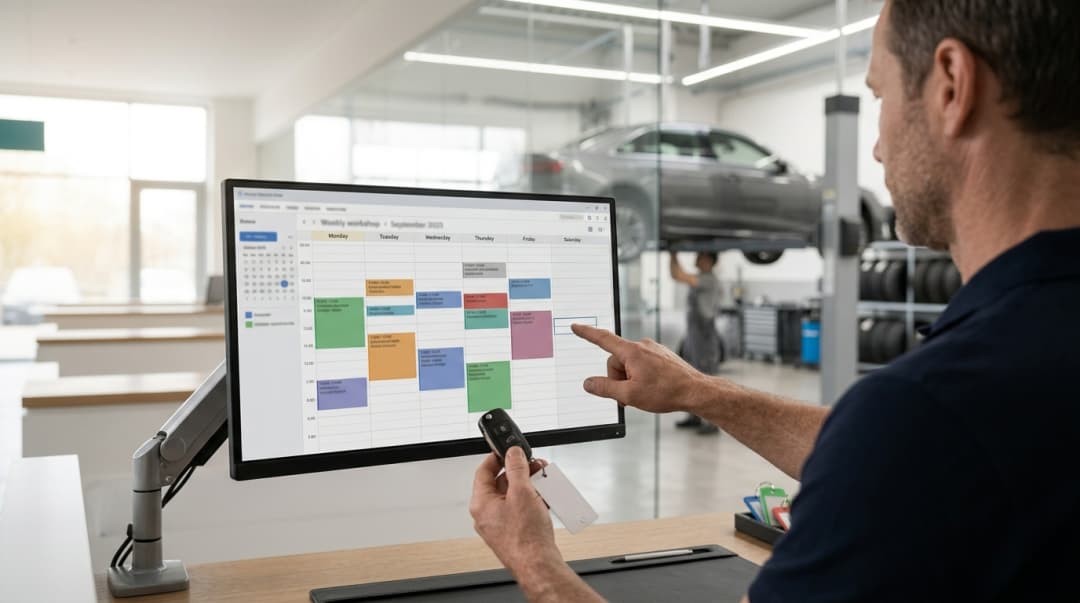
A digital aftersales solution is only as good as its connection to the systems already in use. Every request should leave at least the source channel, registration or vehicle, job type, a readable summary, status and any appointment in the CRM. DMS and CRM platforms do not all expose the same operations: what the customer is promised must match what the integration can actually do.
How conversations, notes and appointments reach the system is explained on the AI CRM for dealerships page; the list of connectable systems is on the integrations page.
A clear handover rule is also needed. With Human Control the service advisor joins the conversation, sees the history already collected and continues in the same thread, while the assistant stops replying. Only one person speaks in the chat.
How to measure digital aftersales
The number of conversations says little on its own. To know whether the process works, separate what comes in from what is taken on and from what becomes workshop work.
- Inbound requests by channel and time of day.
- Time to first useful reply.
- Requests taken on by the service desk.
- Appointments confirmed in the calendar, kept apart from simple preferences.
- Actual workshop visits, where the DMS allows them to be linked to the request.
The Summer 2026 Report shows how to keep technical indicators, activities and outcomes separate. The same method applies to sales, as described on the dealership lead management page.
What should stay with the service desk
Not everything that can be asked by chat or phone should be automated. Diagnosis, non-standard quotes, warranty, complaints and exceptions need technical expertise and accountability. The same goes for confirming an appointment when the calendar is not connected.
A narrow but clear scope works better than an assistant that tries to answer everything. The customer knows what is happening, the service advisor knows when to step in and the history stays reliable.
Where to start
The most practical route starts from the data that already exists and only then moves to conversations. Start with the channel where the most requests are lost today.
- Map which channels Service requests come from today and at what times they go unanswered.
- Define the minimum details to collect for each type of job.
- Check what the calendar, DMS and CRM allow you to read and write.
- Decide who takes ownership of requests and when a person steps in.
- Launch one channel at a time and review it with the service desk after the first few weeks.
Aftersales features and configuration options are covered on the AI for Service and workshop page. This guide is the working outline for deciding what should happen between the customer’s first request and the car on the lift.
FAQ
Frequently asked questions about digital aftersales
The essentials on the aftermarket, bookings, integrations and reminders.
Want to see digital aftersales on your workshop?
In a demo we start from a real Service request: phone, WhatsApp or webchat, data collection, calendar and handover to the service desk on the CRM you already use.