AI receptionist for car dealerships: how AI phone answering works
AI voice agent, IVR, answering service: what changes for the caller, examples across sales, used cars and service, what to check before you switch it on, and when it isn't worth it.
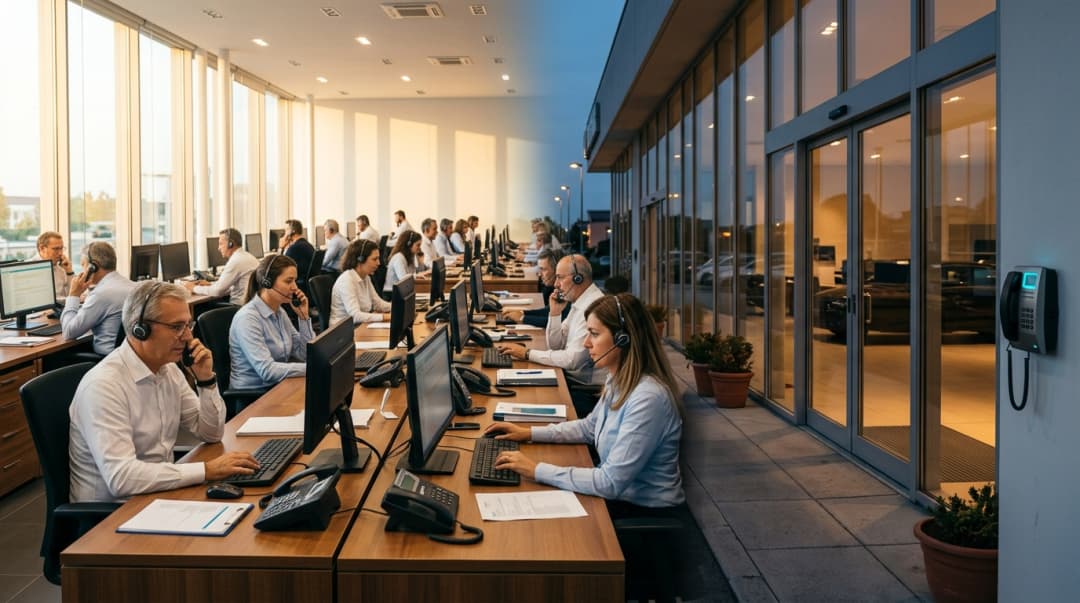
What an AI receptionist is, how it differs from an IVR or a human answering service, what happens on a call, and what a dealership should check before putting one on its main number.
The phone is still the channel where customers expect an answer right away. At a dealership it rings about a car seen online, an oil service, or whether the car is ready to collect. This guide explains what an AI receptionist is, what happens on a call, where it helps a dealership and when it is not worth it.
What is an AI receptionist?
An AI receptionist is a voice agent that answers the business number and understands, in plain speech, why the customer is calling. It asks the questions for that case, such as plate, location or vehicle, and hands a person a ready summary. It does not make callers press keys and does not just take a voicemail.
You will also see it called an AI voice agent, AI answering service or AI phone answering service. The label changes, the job does not: pick up when a person cannot, understand the request and prepare the handoff to the team.
AI receptionist vs IVR, voicemail and answering service
These four are often mixed up in the same quote:
- Voicemail or recorded greeting: gives opening hours and address, then takes a message someone has to listen to.
- IVR: the keypad menu. "Press 1 for sales, 2 for service." It routes calls but does not know what the caller wants and collects no details.
- Human answering service: a call center that takes messages for you. It covers hours, but staff do not know your stock or your service process, and notes often arrive by email.
- AI receptionist or AI voice agent: the layer that talks. It works inside your phone system, understands the request, asks the right questions and writes a summary.
An AI receptionist does not replace the phone system. Numbers, queues and routing stay where they are. The agent steps in when agreed: every line busy, lunch break, evenings, weekends.
What happens on a call
- The customer calls the usual number. If someone is free, they answer; if not, the agent picks up.
- The customer says what they need in their own words: "My engine light is on", "Is the Golf from your listing still available?"
- The agent recognises the case and asks only what that case needs: plate and location for service, model and trade-in for sales, a good time to call back.
- If the rules say so, it transfers the call to a person. Otherwise it ends with a summary.
- The summary lands in the CRM or with the right department, reason already written. Whoever calls back knows what it is about.
Calls are short. At Autocentri Balduina, an Italian multi-site dealer group, the median call lasted 90 seconds across 6,366 calls handled between 15 May and 9 September 2026. The goal is not to solve everything on the phone. It is to capture the first contact properly.
Dealership examples: new cars, used cars, service
New car sales. The caller asks about a model, an offer or a test drive. The agent notes model, location and trade-in, and offers a callback. Final price and negotiation stay with the salesperson.
Used cars. The typical question is "Is it still available?" The agent records the listing, any trade-in and when to call back. If there is no live link to inventory, it does not confirm availability: the team checks.
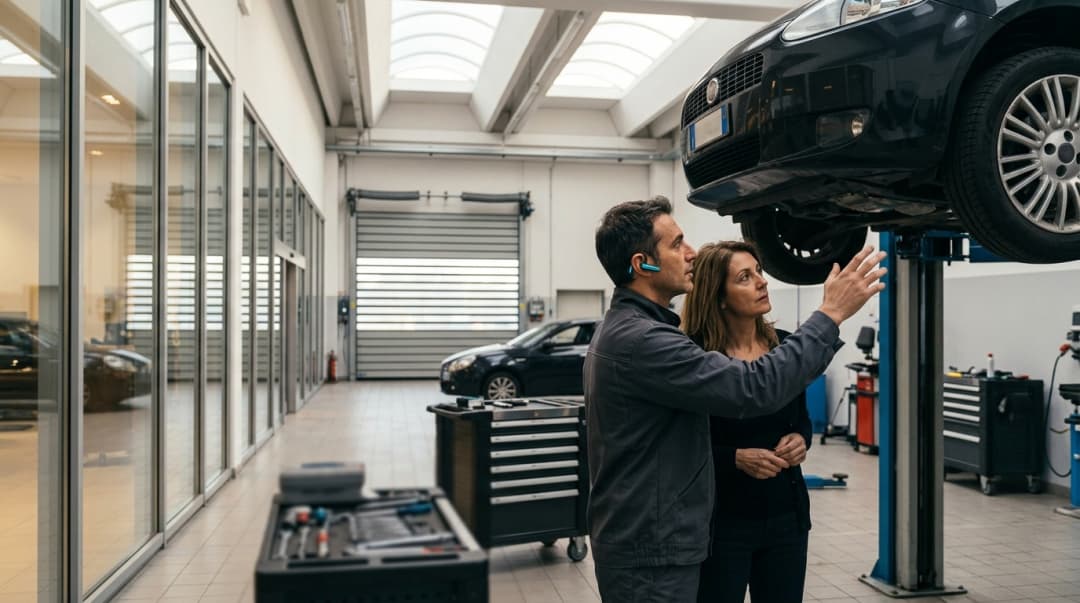
Service department. The most frequent case. Oil service, warning light, repair status, part arrived, pick-up time. The agent records plate, location and reason. The service advisor confirms the slot, or the agent does so only if the connected calendar allows it. For UK readers, this is the garage side of the dealership.
The weight of service is not a guess. At Autocentri Balduina, of the 3,480 opportunities created in the CRM from voice conversations, 2,500 were service requests: 71.8%. New car sales accounted for 655, used cars for 272. It is one dealer group with a 20-person BDC, not an industry average. The Autocentri Balduina case explains how it is set up (in Italian). The service side across phone, WhatsApp and web is described in AI for Service and workshop.
After hours and peak times
Calls do not wait for a free agent. At Autocentri Balduina, taking Monday to Friday 9am–6pm and Saturday 9am–1pm as staffed hours, 17.9% of the calls handled by the agent came outside those hours. The busiest hours sit right next to opening and closing: 346 calls between 8 and 9am, 425 in the 6pm hour.
Across all lead channels, not just phone, the picture is similar. At Ghiraldo & Autoin, in the first half of 2026, 44.7% of observed leads arrived between 6–9am or 6pm–midnight. That is the share for that period, not a before/after figure and not an industry benchmark. The Ghiraldo & Autoin case study also explains what that number does not prove.
Then there are peaks during opening hours: Monday morning, after holidays, recall campaigns. Even a well-staffed BDC has moments when every line is busy. That is where voicemail loses the call and an AI receptionist captures it.
What to check before going live
- Number: customers should keep calling the number they know. Ask whether you need a new number or a forward.
- Phone system: which one you use, and whether the agent joins existing queues and routing or needs a separate setup.
- CRM: where the summary lands, which fields, and who sees it. An email to a shared inbox is not ownership.
- Calendar: can the agent only collect a preferred time, or can it book the slot? That depends on the connected calendar, not on the demo.
- Consent and disclosure: what callers hear at the start, whether and how the call is recorded and transcribed, who can access the data.
- Escalation: when the call goes to a person, what happens if nobody picks up, who calls back and how fast.
- Outbound calls: if planned, for which cases, at what times and with what consent.
How to organise first contact, callbacks and metrics is covered in the dealership BDC guide. An AI receptionist only works if someone owns the summary it leaves behind.
What it costs and what to ask in a demo
Pricing for an AI receptionist varies a lot and comes down to a few drivers. Know them before comparing two quotes:
- Volume: minutes of conversation or calls handled per month.
- Scope: how many locations, departments and call flows (sales, used, service, accounts).
- Integrations: phone system, CRM, service calendar. Each may be included or need dedicated work.
- Outbound calls: lead follow-up, reminders, repair status updates.
- Setup: who writes the questions and rules, and how long it takes to go live.
In the demo, ask to hear a real call on one of your own cases, not a generic script. And ask to see the summary where your team will read it: in the CRM, not on a slide.
When it is not worth it
- Few calls are missed and the team almost always answers: the gain is small.
- Nobody calls back: a summary sitting in a queue is worth no more than a voicemail.
- The CRM does not receive the data and the team will not open another tool.
- You expect the agent to close deals or quote prices on the phone: that is not its job.
- Most calls need an immediate technical judgement only a person can give.
If lines saturate at peak times, the service department gets many repetitive calls and the team has a CRM to work them from, an AI receptionist covers exactly that gap. How MIA works on the phone, with 3CX and on your existing number, is on the AI phone agent for dealerships page.
FAQ
AI receptionist questions
What dealer principals, BDC managers and service managers ask before putting an AI voice agent on the main number.
Want to hear a call on your own phone system?
In a demo we rebuild a real call, sales or service, with every agent busy and the handoff to your team in the CRM you already use.
Related solutions